
TL;DR: This WhatsApp concept explores a simple shift in how people respond to long voice notes. Instead of replying to the entire message, users can reply to a specific moment inside it, with topic, quote, and timestamp preserved. The goal is to make voice-note conversations clearer, more natural, and more respectful of different communication styles.
Communication is one of the most interesting product challenges because every person brings a different rhythm to the conversation.
Some people are fast and direct. Some are detailed. Some prefer voice notes, others text, and most of us are somewhere in between. That tension is what inspired this WhatsApp feature concept: a way to reply to the exact moment inside a voice note that actually matters.
What if voice notes kept their personality, but gained the clarity of threaded conversation?
The problem
Voice notes are expressive, personal, and often more convenient than typing. But they also create a common usability problem: once a message gets long and covers several topics, replying becomes messy.
Right now, replying to a voice note usually means replying to the whole thing. That works fine when the note contains one idea, but it breaks down when someone talks through multiple updates, questions, or thoughts in a single recording.
The result is a small but meaningful loss of context. The reply may be relevant to one exact moment in the audio, yet the interface treats the whole voice note as one block. That makes conversations harder to follow for both sides.
The idea
This concept introduces a more precise reply model for voice notes.
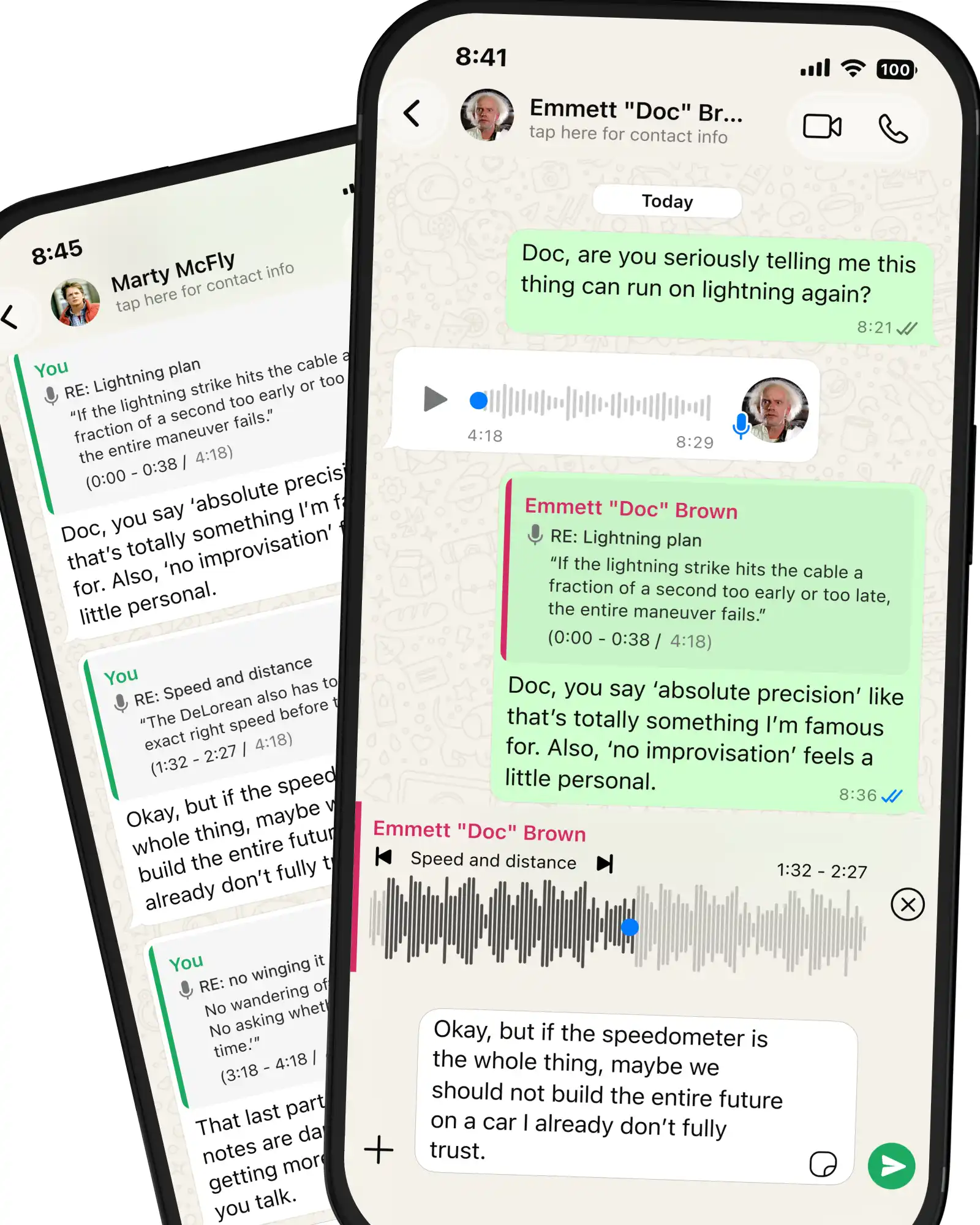
Instead of responding to the entire recording, WhatsApp could break a long voice note into chapters or topics and let the user reply to a specific part of the audio. That reply would stay anchored to the exact moment that triggered it.
To preserve context, the UI would show three things:
- the topic,
- a short quote from that part of the voice note,
- and the exact timestamp.
That small structural change makes the conversation easier to understand without changing the natural behavior people already have. Voice-note senders can still talk freely, while listeners gain a more precise way to respond.
Why this feels important
What interests me here is not just the interaction itself, but the communication philosophy behind it.
Most messaging products still assume that one format should dominate the exchange. Either you adapt to text, or you adapt to audio. But real conversations are more fluid than that.
This concept tries to support both sides at once. One person can communicate in a long-form voice note, while the other can respond with the precision and clarity of text. Instead of forcing one universal style, the product helps different styles work together.
A working assumption, not a rule
The current concept assumes that long voice notes can be meaningfully broken into chapters or topics.
I think that is a strong direction, but it is also worth challenging. Maybe users do not need formal chaptering at all. Maybe selecting a timestamp range would be enough. Maybe the system should detect topic changes automatically, or maybe users should manually mark important moments while listening.
That is part of what makes the idea interesting to me. The real opportunity may not be one exact UI pattern, but the broader principle of making voice-note replies more contextual.
Where the idea can evolve
There are several directions I would want to explore next.
One is whether topic segmentation should be automatic, manual, or hybrid. Another is whether this interaction should appear only for longer voice notes, where context loss is more likely, rather than for every recording.
I would also want to test how this feature behaves from both sides of the conversation. In the concept, the receiver can clearly see which exact part was answered, and the sender can understand the reply in context. That mutual clarity is what makes the idea valuable.
Over time, this could evolve even further:
- lightweight chapters for long audio,
- tappable transcript snippets,
- contextual replies linked to timestamps,
- or filters that help users jump between reply points inside a voice note.
Why this matters
The strongest product ideas often do not remove complexity by flattening behavior. They do it by organizing behavior more intelligently.
That is what this concept is trying to do. It does not ask people to stop sending long voice notes. It simply gives the interface a better way to support what people are already doing.
If the result is a conversation that feels easier to follow, then the feature is doing something useful. It respects the richness of voice communication without sacrificing clarity.
Prototype
Video walkthrough
What I would explore next
The next step would be testing whether users naturally understand chapter-based replies, or whether they prefer a simpler model based on timestamps alone.
I would also want to learn where the biggest friction really sits. Is the core issue that voice notes are too long, that replies lose context, or that different communication styles are not well supported by current messaging interfaces?
That distinction matters, because the best solution may be more about communication structure than audio itself.
Closing thought
Voice notes are not the problem. The problem is that the interface still treats a complex spoken message like one flat object.
This concept asks a simple question: what happens when a messaging app becomes better at preserving context, not just delivering content?
If that shift works, then voice notes can stay human, flexible, and expressive while becoming much easier to navigate.
■ ■ ■ ■
WANT TO JOIN THE CONVERSATION?
CHIME IN ON LINKEDIN →
.